
[ROBOTICS AND MECHANICS - PHYSICAL DESIGN]
SHAPES OF CORNELL
Arduino, RFID, Electronics, Physical Prototyping, Fabrication, Interaction Design
[PROJECT OVERVIEW]: We designed an interactive token dispenser and sculpture building system fostering inter-college connection and
memory making on the Cornell Campus.
[ROLE]
Technical | Hardware & Software
[TIMELINE]
4 Weeks
[TEAM]
4-Person Team
[CONTEXT]
Postive Product Design Studio, Cornell University
CONCEPT DEVELOPMENT
[PROBLEM]
Cornell students often lack inter-college interaction. After completing an initial research survey with 50+ Cornell students we found that...
22%
Rarely interact with students outside their college
45%
89%
Do not explore campus beyond their college
Are interested in an interactive memory making experience
[SOLUTION]
Create an experience that evokes positive emotions and builds shared memories.
[CONSTRAINTS]
The design had to be accessible and engaging for all students, meaning the mechanism needed to be simple, intuitive, and located in a central campus space. Additionally, the device had to have some form of keepsake that was durable, low-cost, simple to produce in multiples, while still allowing for personalization.
[IDEATION]
Before commiting to a final direction we used a sketching phase to explore interaction concepts. Sketches tested multiple machine layouts, dispensing mechanisms, interaction flows, and installation concepts, using quick hand sketches to compare ideas and refine the design.
THE IDEA


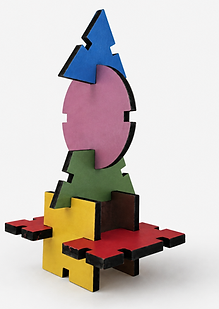
Shapes of Cornell was designed to foster inter-college connection and memory making throughout students’ time on campus, especially during their senior year. Each Cornell college is represented by a unique shape that students collect from the vending machine. Over time, the tokens can be combined into personalized sculptures representing shared experiences and connections across Cornell.
[INTERACTION]
Each Cornell college has its own vending machine that dispenses a unique shape, such as a triangle, square, or circle. To receive a token, two students must scan their IDs together, with at least one student belonging to that college. This encourages students to connect across colleges while collecting shapes from across campus.

[RESULT]
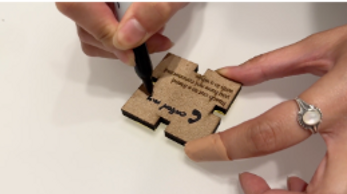
The vending machines dispense tokens. Each token is unique to a Cornell college and includes activity prompts that encourage memory-making and campus exploration. On the back, students can personalize and decorate their token to reflect their individual experience.
INTERACTION DESIGN
[01]
[02]
[03]
DISCOVER
CONNECT
COLLECT

Action: Student decides they want to collect a new token from the Human Ecology College.
Touchpoint: Sees the vending machine on campus

Action: Student asks a peer from Human Ecology to join them.
Touchpoint: Both students scan their Cornell IDs

Action: Machine dispenses a brightly colored token with a positive prompt.
Touchpoint: Tray opens, user receives token
MECHANISM DECISION MAKING
[DUAL ID DETECTION]
Encourages collaboration between students from different colleges
[LED FEEDBACK]
Provides immediate, intuitive
visual confirmation of success or error
[BUZZER CHIME]
Creates a playful, satisfying
audio cue to reinforce interaction
[SERVO ROTATION]
Key movement to dispensing one token at a time
[GRAVITY RELEASE]
Ensures a simple, durable,
and reliable way to deliver shapes.


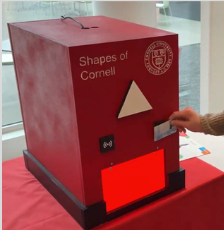
One Person - Failure

Two People - Success
DESIGN DECISION MAKING
[MATERIAL]
Prototype built from foam board and wood for quick iteration and low cost, balancing time and resource constraints. Shapes are sized for easy handling and durability, designed to withstand repeated interactions.


[INTERACTION AND PARTICIPATION]
Two-ID requirement ensures collaboration between students from different colleges, reinforcing inter-college connection. RFID scanning provides an accessible and familiar method of interaction, lowering the barrier to participation.
[FORM AND REPRESENTATION]
Each Cornell college is represented by a unique shape, giving students tangible symbols of their academic community. Tokens are designed to interlock and
combine, so individual contributions build into a collective sculpture.

[VISIBILITY AND ENGAGEMENT]
The front-facing dispenser makes the interaction visible to passersby, drawing attention to the machine and encouraging participation. Each token can be personalized with the shared experience it represents, turning the collected shapes into a record of memories made across campus.
PROTOTYPE CONSTRUCTION PROCESS
The installation was built through an iterative fabrication process involving mechanism testing, laser-cut assembly, electronics integration, and hand-finishing. Each stage refined both the physical build and the interactive experience, resulting in a durable, exhibition-ready prototype.


Laser Cut Shapes
Mechanism Prototyping
RFID Trial and Error
Center Shape Magnetic Attachement
Dispenser Door Construction
Electronics Installation
Painting and Finishing touches
DEMONSTRATION


REFLECTION
This project taught me how to translate an abstract social goal into a tangible, buildable experience. I strengthened my skills in prototyping, electronics, and fabrication while learning to make design decisions around real user behavior. Most importantly, I learned how to build a flexible system that creates a consistent interaction while still leaving room for each user to make the experience their own.