
[ROBOTICS AND MECHANICS - PHYSICAL DESIGN]
THE INVISIBLE CONTRACT
Arduino, Python, API Integration, Electronics, Physical Prototyping, Fabrication
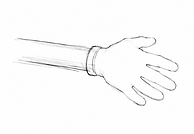
[PROJECT OVERVIEW]: We designed The Invisible Contract, an interactive robotic handshake that transforms AI data consent into a physical experience. The device features a silicone-cast hand mounted on a mechanical acrylic arm. It measures grip force, tilt, and handshake duration during each interaction. This data is then translated into a personalized spoken response about the data exchange the user has just entered.
[ROLE]
Technical | Hardware & Software
[TIMELINE]
8 Weeks
[TEAM]
2-Person Team
[CONTEXT]
AI Product Design Studio, Cornell University

CONCEPT DEVELOPMENT
For this project, my team and I were tasked to create a commentary on “Machine Eyes.” From this open brief, we explored how increasingly human-like interactions with AI can obscure the exchange of data, trust, and personal information happening behind the scenes.
We wanted to make these invisible agreements tangible. Instead of clicking “Accept,” users consent through a handshake—a familiar symbol of trust and agreement. By turning digital consent into a physical gesture, The Invisible Contract asks users to consider what they are actually agreeing to when they interact with AI.


INTERACTION DESIGN


The Invisible Contract features three distinct interaction types. Each begins with the system requesting access to a specific part of the user’s digital life. The user responds through a handshake, measured by duration, force, and rate of tilts.
ENTHUSIASTIC AGREEMENT
[01]
The user shakes firmly and intensly. The system reads this as willingness

HESITANT AGREEMENT
[02]
The user and gives a weak handshake. The system analyses their hesitancy to adopt

REFUSAl
[03]
The user does not shake the hand. The system acknowledge what they have chosen to given up.

REFLECTION
[04]
When we interact with generative AI, we communicate in deeply human ways through conversation, expression, and social cues, because that is how we naturally make ourselves understood. But AI does not experience these interactions the way we do. By reducing this abstract relationship to something as simple and human as a handshake, the installation exposes that divide. A gesture of trust and connection is reduced to measurable data: force, duration, and motion. Thus revealing the inherently human meaning that AI can interpret, but never truly experience.
The system responds by describing an exaggerated future where the requested data is used to an almost absurd extent. This intentionally uncomfortable outcome pushes the user to question what enthusiastic agreement might actually permit.
The system responds by showing how hesitant adoption can gradually become dependence. What begins as occasional use grows increasingly frequent as the user is pressured to rely on the technology, eventually making it difficult to function without it.
The system responds by revealing the consequences of opting out. The user retains control of their data, but is increasingly excluded from conveniences, services, and opportunities that depend on the technology.
DESIGN DECISIONS
[PHYSICAL INTERACTION]
Designing the interaction required multiple rounds of experimentation to determine how a human handshake could be meaningfully interpreted by the system. We tested several data collection methods, including motion sensors and spring-based pressure mechanisms, before refining the interaction to use a force sensor and tilt sensor. This combination reliably captured grip force, handshake duration, and tilts per second, providing enough information to quantify each handshake while keeping the interaction simple and intuitive for users.
System Power

Silicon "AI" Hand
Mechanical arm made from acrylic pipe and internal wiring
Mechanical Pivot
Reflective base made from recycled bin

[SILICONE HAND]
I cast my own hand in translucent silicone, creating a form that feels human yet unmistakably artificial.

[MECHANICAL ARM]
The transparent acrylic arm keeps its internal wiring visible, subtly echoing veins beneath the surface.
[AI PROMPT DESIGN]

[VISUAL FEEDBACK]
A soft internal light pulses as the AI speaks, giving the interaction a more conversational feel.
The most time-consuming part of this project was AI prompt design and iteration. While we made many shifts throughout the process, three major iterations shaped the final experience.
[01 PROMPT]
Personality Analysis

Our first approach used the handshake data to have AI characterize the user’s personality based on how they shook the hand. However, the responses were often generic and inaccurate, making them difficult for users to connect with. We also found that the handshake itself did not feel intrinsic to the concept, pushing us to create a stronger relationship between the physical interaction and the AI response.
Example Response:
"You seem cautious and introverted."
TOO VAGUE
[O2 PROMPT]
AI Asks for Consent
For our second iteration, we reframed the handshake as a form of consent. The AI asked for access to a piece of the user’s personal data, and their handshake determined their response. The AI then described the world they had just agreed to enter. While this created a stronger connection between the interaction and concept, the broad prompt produced repetitive and vague narratives that were not specific enough to create the discomfort we wanted.
"Will you allow AI access to your personal data?."
User Accepts

User Rejects
MORE DIRECT
[03 PROMPT]
Consent in Context
In the final iteration, we introduced 30 data consent categories spanning different areas of digital life, including biometrics, location, finances, and personal communications. The AI randomly selects a category for each interaction, creating more varied and specific speculative narratives. We also added a user count showing how many previous participants had accepted the same request. This was designed to create a sense that the world is already shifting toward this kind of technological dependence, making participation feel increasingly difficult to opt out of.


30 Consent Categories
Specultive Responses

Live User Count
MOST IMPACTFUL
CONSTRUCTION PROCESS
Constructing the installation required integrating hardware, electronics, and fabrication into a single interactive system. The prototype was built using a custom Arduino setup, embedded force and tilt sensors, a cast silicone hand, a transparent acrylic arm, and a repurposed metal enclosure. Multiple rounds of wiring, calibration, and physical testing ensured the sensors responded consistently while maintaining a natural handshake experience. The result was a fully functional installation capable of translating human interaction into AI responses.


Final Arm Joint
Final Hand Mold
Enclosure Upcycling
Custom Hardware Assembly and Testing
Hardware Installation
Hand Attachement
Hand Mold Testing
Initial Enclosure
Arm joint iteration
DEMONSTRATION

REFLECTION
This project strengthened my skills in electronics, sensor integration, python coding, and API integration while challenging me to think critically about trust and human-AI interaction. I learned the importance of designing products that respect user expectations and make transparency a core part of the experience.